
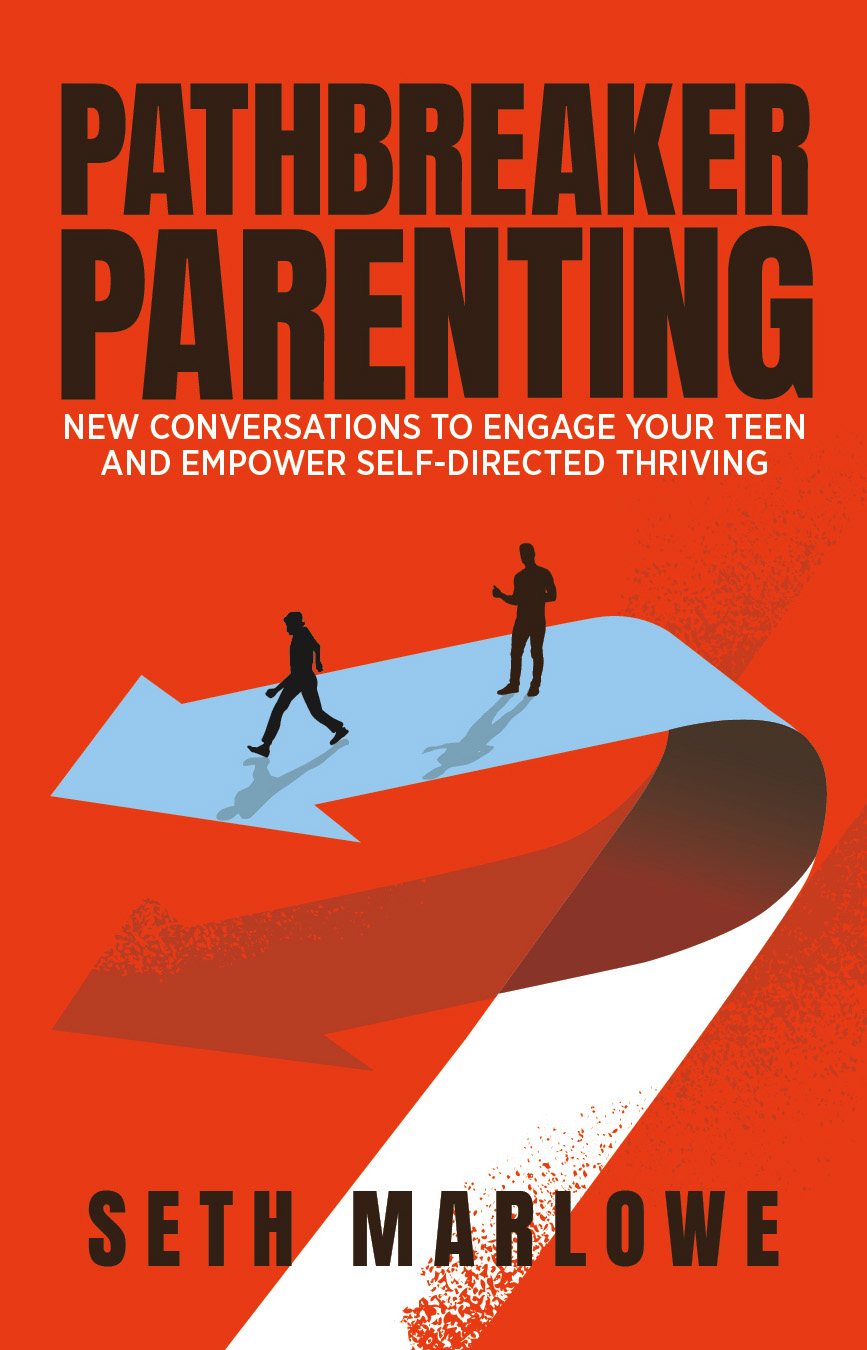
The book · Pathbreaker Parenting
Your teen doesn’t
need more conformity.
They need the wheel
A teardown of the path every teen is handed, and new conversations to replace it.
Also on eBook and audiobook · Signed & inscribed, $35 →
“This is parenting gold. I hope many young parents will take this sage advice.”
— Chris Arnold, father of four (ages 14–20)
Want the full case for why the old path is failing? Read The Problem →
Start here
Who this book is for
Read it if
- ✓Your teen is anxious and stressed from chasing grades and credentials.
- ✓You feel like you’re a taskmaster at the exact time your kid needs a mentor.
- ✓You’re tired of making decisions based on what the other parents will think.
- ✓You’re increasingly unsure that college is worth what it costs.
Skip it if
- ✕Your teen is thriving on the standard path and you have no real doubts.
- ✕You believe your kid needs taskmastering more than they need a mentor.
- ✕You need the people around you to agree with how you’re raising your kid.
- ✕You believe college should be the north star every teen points toward.
The question that matters most
How important is it to you that your kid gets into a college other parents will be impressed by?
If your honest answer is “ugh, more than it should,” then keep scrolling.
The part nobody wants to admit
The rule nobody wrote down and everybody obeys
I live in Charlotte, North Carolina, and the rule here is the one you already know. You send your kid to college right after high school. Period. Good parents send their kid to a recognizable college. The best parents send theirs to an elite one. So when our daughters were in high school, parents always asked each other, “What colleges is she looking at?” And I noticed there were three tiers to that answer. Still are. The only difference where you live is the college names.
Tier 1: The elite colleges for the elite kids
You get to say the name and stop. No context, no explanation, no “but they have a great program in…” The name does all of it.
- Ivy League 4–9%
- Duke 6%
- Vanderbilt 6%
- Davidson 13%
- Georgia Tech 14%
- UNC Chapel Hill 15%
- Virginia 17%
- Wake Forest 22%
Tier 2: The brand name schools for the regular kids
You get a nod. No explanation needed. But you probably add something anyway, because a nod wasn’t quite what you were hoping for. Great business school. Huge alumni network. Awesome tailgating.
- Clemson 38%
- Georgia 38%
- NC State 42%
- Tennessee 42%
- Virginia Tech 55%
- South Carolina 60%
- LSU 73%
- Alabama 77%
Tier 3: The schools people feel they have to explain
You feel the need to explain. She fell in love with the campus. He’ll do two years and transfer. She got a partial scholarship. Nobody asks you to explain a Duke.
- Charleston 60%
- UNC Wilmington 64%
- Coastal Carolina 75%
- High Point 75%
- UNC Charlotte 80%
- East Carolina 89%
- UNC Greensboro 89%
- Appalachian State 90%
So what’s the point?
The point is that obedience writes checks your teen can’t cash. The pressure is no longer “get accepted by a college”; it’s “get accepted by a college other parents will be impressed by.” The result: your teen carries anxiety, stress and fear daily, even though 85% of four-year colleges admit half or more of all applicants.
It has turned the high school years into an audition, where parents become taskmasters and teens become résumés.
Of four-year colleges that make an admissions decision, 85% admit half or more of their applicants. US Department of Education (IPEDS), fall 2024.
A tool from the book
Every decision is a bet, and every bet has four costs
Successful people are not better at avoiding risk; they are better at pricing it. Most teenagers never learn to price anything because they are too busy conforming. So taskmaster and teen place the biggest bet of their lives, and price exactly one of its four costs.
This is one of the book’s conversations, and one you can have this week. It comes from a chapter called Rethink Risk: start with the smallest bet your teen already understands, where the four costs are obvious, then run the same four on the biggest bet they will ever place.
The same four costs. Two very different bets.

5 hours
A lemonade stand
Saturday. Nobody shows up.
- Hard costs
- A few bucks.
- Soft costs
- You feel disappointed your table failed.
- Time
- Set up, sit behind the table, break down.
- Opportunity cost
- An afternoon at the pool with your friends.

5,440 hours
Four years of college
Paid in full before the outcome.
- Hard costs
- About $140,000 all in, at $35,000 a year.
- Soft costs
- Years of stress, anxiety and pressure, paid daily.
- Time
- About $25 an hour, every hour, for 5,440 hours in a row.
- Opportunity cost
- Everything else those hours and that money could do.
The book uses $140,000 ($35,000 a year) for this exercise. Average total cost of attendance in 2025–26 was $29,910 a year for in-state public, $49,080 out-of-state public and $62,570 private nonprofit; over four years, about $120,000 to $250,000. College Board, Trends in College Pricing and Student Aid 2025. These are published prices, and grant aid lowers what many families pay. It does not shorten the 5,440 hours, which are 136 active weeks at 40 hours.
College has no small version
A lemonade stand is a small bet. Even when it flops, your teen learns their neighborhood is not a good place to sell lemonade, and next Saturday they try something different. College has no small version. Even on a full scholarship it is an enormous bet with an unknown outcome. It is exactly the kind of bet adults spend their lives avoiding, but we ask teenagers to push their chips to the center of the table and hope it all works out.
This is not an argument against college. It is an argument against betting blind.
If that made you pause, read the first four chapters. A 20 minute read. They’re free.
Send me the chapters →How the book is built
202 pages. Three-hour read.
Five sections. The first three build the case. The last two are what to do about it.
- 1
Houston, We Have a Problem
Why the conventional path is failing today’s teens, the requirement lie about college, and the first new conversations to start having.
- 2
What Drove My Conviction
Short stories from my own road through school, career, and parenting, and the moments that turned me skeptical of the path.
- 3
The Path
A step-by-step teardown of the six-step map every teen is handed, from good grades to the promise of fulfillment at the end.
- 4
Growth Mindset
The foundation that replaces the path: play the long game, let go of grades, embrace uncertainty, and rethink risk.
- 5
Thrive
Eight new conversations, one per chapter, that hand your teen the wheel.
From readers
What readers wrote to me
“As a high school history and social studies teacher, I think this book is compelling for parents and teens. The chapter on getting children to think of and consider the cost of everything is extremely important and is often overlooked in traditional classroom settings. I was also unaware how much the Internet has altered access to job interviews, degrees, workshops and certifications for some trades. All of this was quite enlightening.”
— Michael McCulloch, Teacher of the Year, 2025–26
“While there were certain things I didn’t fully align with, I think what Seth brings to the table is an opportunity to engage in a much-needed conversation about what it actually means to parent children we hope will become fully functioning, responsible adults. The book challenges us to think beyond simply preparing our children to fit into the world as it exists and instead consider whether we are giving them the mindset, tools, and responsibility they need to navigate life for themselves.”
— Odell White, father of two pre-teens
“I landed my position as a data analyst not because of my new degree, but mostly because of the skills behind it. This was perfectly described in your book. This is the first time I have ever written an author about a book, but I wanted to say thank you; it resonates deeply with me.”
— Magon Bowling, mother of two teenagers

Who wrote this
Seth Marlowe
I spent thirty-two years in business, eleven of them in the chair that decided who got hired, fired and promoted. I never once picked someone for where they went to school. This is one father’s argument, not peer-reviewed research.
Not convinced yet
Read the first four chapters free
Fair. A 20 minute read, and section one runs the whole argument in miniature. Enter your email and I’ll send it.
No spam, ever. Unsubscribe anytime.
Check your inbox, and here are your chapters right now:
Download the first four chapters →Convinced
Get Pathbreaker Parenting
Then pivot from taskmaster to mentor. Paperback, eBook, or audiobook, on Amazon.
Want it signed and inscribed to your teen? $35, shipped →
Buying in bulk for a school, team, or organization? Get in touch →